Saturday, July 23, 2011

Tuesday, May 31, 2011
Discovering a new Cox's Bazar

On a sunny warm morning, we arrived in Cox's Bazar. It was a long time since I last visited this place -- my reason to avoid it was the huge crowd that I always loathed. You have no privacy. Secondly, with the fall of dusk Cox's Bazar turns into the most boring sea resort I have ever visited. There are no clubs, no entertainment facilities. You just shut yourself up behind the hotel doors and brood over your gloomy years.
So I came here with much trepidation. But what struck me as our car coasted through the busy town is the amount of money that has gone into tourism here -- newer and newer hotels have shot up into the sky and funnily none of them are empty even on this supposedly off-season. Rickshaw fare is astronomically high to piss off any traveller. And tourists were visible even more now -- the middle-class is going out more and more, they are becoming holidaymakers. But still no signs of any clubs or entertainment spot. So, with the conservative Cox's Bazar, tourism stops there.
After we had checked into the forest guesthouse right on the beach (by the way, this is the only staying place closest to the sea), we took a stroll on the beach. We walked a long distance to a quieter place, a huge fishing boat had been beached for repair. It lay banked on one side. We took a dip in the sea to ward off the heat and then sat in the shade of the boat until we felt another need for a swim.
The temple at last

What surprised me more was the backyard of the station. A long pier about ten feet above the ground had run to the toilets. And it was protected with tightly knit golpata partition all the way. The floor was also made with solid wood.
Naturally Narail

On a perfectly nice winter morning, we parked our car at the Mawa police station for two nights and went over to the speedboat terminal. On the other side of the Padma would wait a microbus. This arrangement would have been the quickest to Narail. With a heavy backpack and the jacket wrapped round my hand, I first stepped on the front deck of the speedboat. As I was about to step inside the canopy, two more halfwit fellow travellers with no knowledge of a speedboat's behaviour jumped in.
It took a second for the boat to rock vigorously, like a bucking horse; and the next second I found myself floating on the Padma. My backpack felt like a tonne of brick and impossible to dislodge. My jackets were fitted tightly. Somehow I swam against a current that was trying to carry me out to the middle. Then I found the white hull of the speedboat above my head. I grabbed its edge and calmed myself.
Then I was laughing manically. All those birdbrains responsible for the mayhem and my watery state were also in water. All with their backpacks and one of them swimming like a rat thrown into the pond.
There were people stretching out their hands to me and I caught a few of them, or they rather caught me and pulled. Try to climb onto a speedboat from the river and find out how difficult it is. Almost when I was thinking the rest of my life would be spent on the Padma bobbing like the float of a fishing rod, they landed me on the deck. The rest were rescued as well.
Tuesday, May 17, 2011
Beautiful Bangladesh | visit here, before others do!
It was the time of the festival of Bon Bibi, the protecting goddess of the Sundarbans, and we were winding our way down into the forest aboard the M.V. Chuti. My mother had just passed along her copy of Amitav Ghosh’s The Hungry Tide to me to read. Coincidentally, I was also carrying the classic 17th century travelogue of Moghul India, Francois Bernier’s Travels in the Moghul Empire. Little did I realize how connected these two books were, or how closely they would parallel my own experience of the “beautiful forest”.

“…The most striking and peculiar beauty of Bengale is the innumerable islands filling the vast space between the two banks of the Ganges. These islands vary in size, but are all extremely fertile, surrounded with wood; a thousand water-channels run through them, stretching beyond the sight, and resembling long walks arched with trees…”
Little had changed in the three and a half centuries since Bernier coa
Little had changed in the three and a half centuries since Bernier coasted through these waters. Except that the Sundarbans had shrunk considerably, due to constant human encroachment.
Sunday, February 20, 2011
Wednesday, July 21, 2010
Tajhat Rajbari / Rangpur Museum
Just south of the city of Rangpur lies the Tajhat, a former "rajbari" or zamindar's palace. After the end of the British Raj, the building was abandoned and decayed rapidly, although it was used for a few years as a courthouse during the 1980's. In the year 2004, it was largely restored and turned into a museum with ancient inscriptions, art and coins from the area on display


Muktagachha Palace


 The Muktagachha zamindars of Mymensingh were well known in this sub-continent for the various work they did and luxurious lives. People of the district remember them with respect for their contributions, especially to the education sector. Muktagachha is now a merely an upazila sadar, though at one stage 16 of the zamindar inheritors controlled their administration from this place. History says that Sree Krishna Acharya Chowdhury of Bogra was the first to establish zamindari here. He took on lease Alepshahi Pargana (estate) one of the 22 estates of Bengal in 1727 from Nawab Alibardi Khan. Later, the three parganas: Alekshahi, Momenshahi and Hossainshahi were merged into after the death of Isha Khan. It was after the merger that Sree Krishna Acharya obtained the zamindari of Alepshahi estate from Murshidabad on obtaining it, Sree Krishna returned to Muktagachha by boat along the Brahmaputra river. Mukta Ram -- a poor and humble artisan -- welcomed him with the presentation of a brass lampstand. This gesture kept alive Mukta Ram's name and the zamindar's palace was named Muktagachha. Its previous name was Binod Bari. The area at the time was hilly and full of forests abundant with wild animals. Only a few fisher families lived there. Later, Sree Krishna allowed immigrants to settle in and start cultivation. Zamindar Sree Krishna had four sons -- Ram Ram, Hori Ram, Bishnu Ram and Shiva Ram. Raghu Nandan the son of Shiva Ram allotted necessary land for the establishment of Mymensingh town in 1787. Later on, Gouri Kanta, Kashi Kanta, Suryo Kanta and Shashi Kanta -- Shiva Ram's next generation -- made greater contributions to upgrade the name and fame of zamindars of Muktagachha. Jagat Kishore Acharya Maharaja was another influential among the zamindars. He was the son of Hori Ram and a zamindar of Aatani (half portion) of the total estate. Kumar Jeetendra Kishore and Kumar Bhupendra Kishore were Jagat Kishore's sons. Jeetendra had a great liking for music while Bhupendra was devoted to drama. Raja Jagat Kishore constructed an opera house titled Bhupendra Rangapith with a revolving stage. It was the second revolving stage in the Indian sub-continent. Jagat Kishore had a collection of over 10,000 books in his library -- the largest in East Bengal. After the partition in 1947, the books were handed over to the Bangla Academy as "Muktagachha Collection". Jagat Kishore started Bidyamoyee Girls High School, which still retains its fame as a government girls school and Ram Kishore High School at Muktagachha after his mother Bidyamoyee Devi and father Ram Kishore. Suryo Kanta's lodge is now being used as Muktagachha Shaheed Smriti Govt College. Various institutions still bear testimony of Suryo Kanta. Such are Raj Rajeswari Water Works, Shashi Lodge, Alexandra Castle, Suryo Kanta Hospital and the Town Hall. Suryo Kanta also donated land worth Tk two lakh to construct the Dhaka-Mymensingh railroad. Suryo Kanta was very hospitable person. Many famous personalities of the then Indian sub-continent and outside visited his palace on various occasions. Lord Curzon, the British government representative, in a letter on February 17, 1902 wrote: "I must in leaving, write you a brief line of thanks for your hospitable entertainment to me during the last two days and regret that your illness has prevented you from taking any part in it. I should have greatly enjoyed your company both here and in Gour." The zamindars of Muktagachha constructed many temples, puja mondaps, made large ponds, gardens and nat mondirs for their subjects. But with the passage of time, memories of the zamindar's palaces and other establishments go into oblivion, because of lack of repairs and maintenance. It is difficult to even recognise that these ruined palaces were once used by zamindars, whereas all the palaces had super luxuries with various moments along with herds of elephants. But reality is that bushes, shrubs and creepers have covered the once beautiful yards of the palaces. It is way beyond anyone's imagination that human beings dwelled in these palaces. Today there is no sign of the houses of Shashi Kanta and his son Jibendra Kishore. Miscreants broke down the walls and pillars of Jibendra Kishore's house when they heard that five bricks made of gold were hidden in the house. The house where the elephants were kept, dungeons, revolving stage, courts, the places where the mummified skulls of elephants head and the bodies of two Royal Bengal Tigers were preserved, have gone on the verge of extinction. Bats are seen flying in and out of these old establishments. The Archeological Department took the charge of the palaces of Muktagachha about 12 years back but no work has yet been done. Visitors enter the palaces everyday only with permission from the authorities concerned. As the young people move here and there, accidents may take place at any moment because of the dilapidated condition. The palaces could be an attractive tourist spot with a source of income. Immediate efforts must be made to preserve our past glory for the future generations. Story: Aminul Islam, (C) Copyright thedailystar.net
Shah Muhammad Mosque
 Shah Muhammad Mosque is situated at Egarasindhur under Pakundia upazila of Kishoreganj district, less than half a kilometre to the east of the Sadi Mosque (1652). The mosque is now in a better state of preservation due to a series of repair works by the successive Departments of Indian, Pakistan and Bangladesh Archaeology.
The mosque stands at the back of a slightly raised platform, which is enclosed by a low wall with a gateway in the east. The gateway consists of an oblong structure with do-chala roof. The mosque proper is a square structure, 5.79m a side in the inside, and is emphasised with octagonal towers on the four exterior angles. All these towers, shooting high above the roof and terminating in solid kiosks with cupolas, were originally crowned with kalasa finials, still intact in the southwestern one. The eastern facade is pierced with three arched-doorways having cuspings in their outer faces, while there is only one on either of the north and south walls. The western wall accommodates inside three mihrabs - the central one semi-octagonal and the side ones rectangular. The central doorway and the central mihrab are larger than their flanking counterparts. The mosque has four axially projected frontons, each corresponding to the centrally located doorways and the central mihrab. Each of these frontons is again distinguished by bordering ornamental turrets on its either flanks, which are carried beyond the parapets. The parapets and cornices are horizontal in the usual Mughal fashion.
The building is roofed over with a large dome on an octagonal drum, the dome being crowned with expanded lotus and kalasa finial. The drum of the dome rests directly on small half-domed squinches and blocked arches springing from the waist of the walls.
The do-chala gateway building is now smoothly plastered over, while the mosque proper is enriched with both plaster and terracotta designs. The eastern facade of the mosque depicts at either end horizontal rows of arched panels, each being marked with plant motifs in terracotta. The three eastern doorways were originally decorated with terracotta, still preserved in the central archway in decaying condition. The outer surface of the remaining three walls are distinguished by shallow large panels - both square and rectangular. Raised bands divide the corner towers, while their faceted kiosks on the top are marked with blind arched-motifs. The flanking turrets of the projected frontons depict jar-shaped pedestals. The parapets and the octagonal drum of the dome are adorned with frieze of blind merlons.
All the mihrabs are enriched with terracotta decoration. The mihrabs are arched having cuspings in their outer faces. The pilasters, supporting the mihrab arches, show a series of decorated bands topped by a frieze of petals. The spandrels of these arches, though now plain, must have been originally enriched with terracotta plaques. The mihrab niches are internally divided by moulded bands into a series of panels, which depict varieties of plants. And the whole mihrab composition is enclosed within a rectangular frame, the frame being filled with intersecting scrolls forming loops with flowers. Above the rectangular frame of the central mihrab there is a row of arched-niches filled with varieties of small trees containing flowers.
The squinches and blocked-arches, which carry the thrust of the drum of the dome, are beautifully cusped. The octagonal drum and the dome above are internally demarcated by a raised band, which is topped by a row of merlons and followed by a frieze of arched niches. And the apex of the dome inside is depicted with a large tiered rosette.
The mosque should specially be noted for its four axially projected frontons with bordering ornamental turrets, a device which must have been borrowed from the four axial iwan-type gateways of the Persian influenced north Indian Mughal standard mosques of Fathpur-sikri, Agra and Delhi. It is in this particular feature and also in plan the mosque compares well with the allakuri mosque (c 1680) at Dhaka. Stylistically therefore Shah Mohammad's Mosque at Egarasindhur may be dated sometime around 1680 AD.
Monday, July 19, 2010
Hossaini Dalan at Old Dhaka City

Husaini Dalan a Shiite shrine in the old part of the city of DHAKA, attributed to the Mughal Period. It is a common practice among the Shia community to build edifices to commemorate the martyrdom of al-Husain, at the battle of Karbala in Iraq on the tenth day of Muharram 61 AH (10 October 680 AD). The building seems to have been originally erected by one Sayyid Murad during the governorship of SHAH SHUJA, who, although himself a Sunni, was eager to preserve and patronise Shiite institutions. Traditions relate that Sayyid Murad, having seen al-Husain in a vision erecting a tazia khana (house of mourning), was inspired to raise the building, which he named Husaini Dalan. The original building may have been a small structure, expanded to its present form in later times. The EAST INDIA COMPANY repaired it in 1807 and 1810, and a portion of the building was reconstructed after the earthquake of 1897.
Rabindranath Tagore's Shahzadpur Kuthibari, Sirajgonj

Gandhi Asram
 Situated about 23 km. north-west of Choumuhani town and 2 km. east of Chatkhil at Jayag in Noakhali district. This asram was established in the memory of historic visit of the Mahatma Gandhi to Noakhali and devoted to his ideology. In 1946-47 Mahatma the protagonist of Ahimsa ideology visited this region with a view to preach peace. Historical Charka and other valuables used by Mahatma are preserved in this asram and those evoke deep respect to the unique memories of the great soul.
World War II Cemetery


In this well-preserved cemetery,in Chittagong lie burried over 700 soldiers from Commonwealth countries and Japan, who died during the Second World War.
Suhrawardy Uddayan

At a stone throw distance from Dhaka Sheraton Hotel and stretching out Dhaka University campus and Bangla Academy, the Suhrawardy Uddyan, formely known as the race course, is a testament to our great historical achievement. It is here that the clarion call of independence of Bangladesh was declared on 7th March 1971 by Father of the Nation the great national leader Bangabandhu Sheikh Mujibur Rahman and it is again here that the commander of the Pakistani Occupation forces surrendered on the 16th December 1971 to the joint command.
Baldha Garden

Established in 1904, by the late Narendra Narayan Roy, the garden is located in Wari (opposite to the Christian cemetery). This garden boasts a rich collection of indigenous and exotic plants. Open: Saturday-Thursday, 9:00 a.m.-5:00 p.m. Friday closed. Entry tickets are available on the gate.
Bahadurshah park

Located at old city opposite the Jagannath University formerly Victoria Park this memorial place of 1857 was built to commemorate the martyr's of the first liberation war in the years of 1857-59 against British Rule. This is the place where the revolting sepoys and their civil compatriots were cowardly hanged. The ancient name of the place was "Antagor Maidan".
Martyred Intellectual Memorial

National Memorial
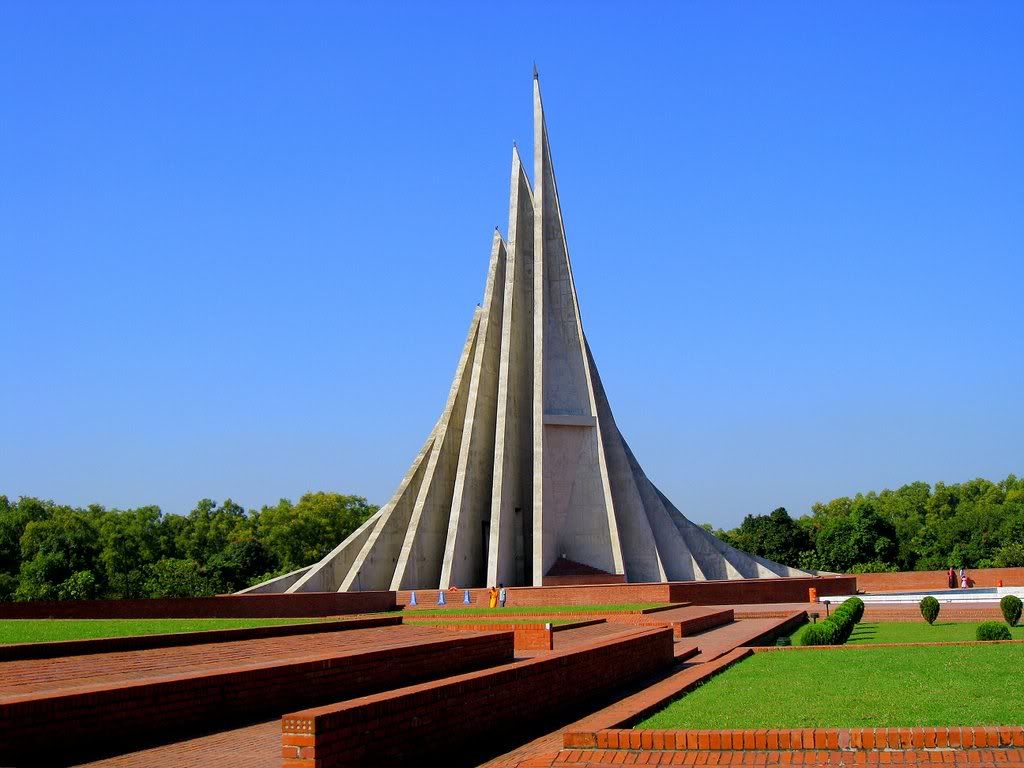
Located at Savar, about 35 km from Dhaka, the national memorial was designed by architect Moinul Hossain. It is dedicated to the sacred memory of the millions of unknown martyrs' of the war of liberation in 1971.
Parki Beach
 Parki beach is situated in Gahira, Anwara thana under southern Chittagong region. The beach lies about 28 km. away from Chittagong city. As the beach is situated at the Karnaphuli river channel, visitors can view both the Karnaphuli river and the sea together. Tourists enjoy the views of big ships anchored at the outer anchor, fishermen catching fish in sea, sunset, various coloured crabs at the beach, and quiet environment. In picnic season, many visitors come to the beach. | |
Location and transportation Parki beach lies at Karnaphuli river channel, which is about 8 km. from Anwara thana and 28 km. away in the southern part of Chittagong city. This sandy beach is about 15 km. long and 300 - 350ft. wide with 20 km tamarisk forest created by the forest division. Anwara thana is 20 km from Chittagong. Anwara thana is connected by road with Chittagong - Cox's Bazar highway and is accessible from all over Bangladesh including Dhaka city. The beach is located 8 km. away from the Chatri Choumuhoni point in this highway. | |
Subscribe to:
Posts (Atom)